Lighting comparison
Flos vs Artemide
The two houses that defined modern Italian lighting. Flos makes light into sculpture — the object you display. Artemide makes light into a tool — “The Human Light” that works. Most great schemes use both.
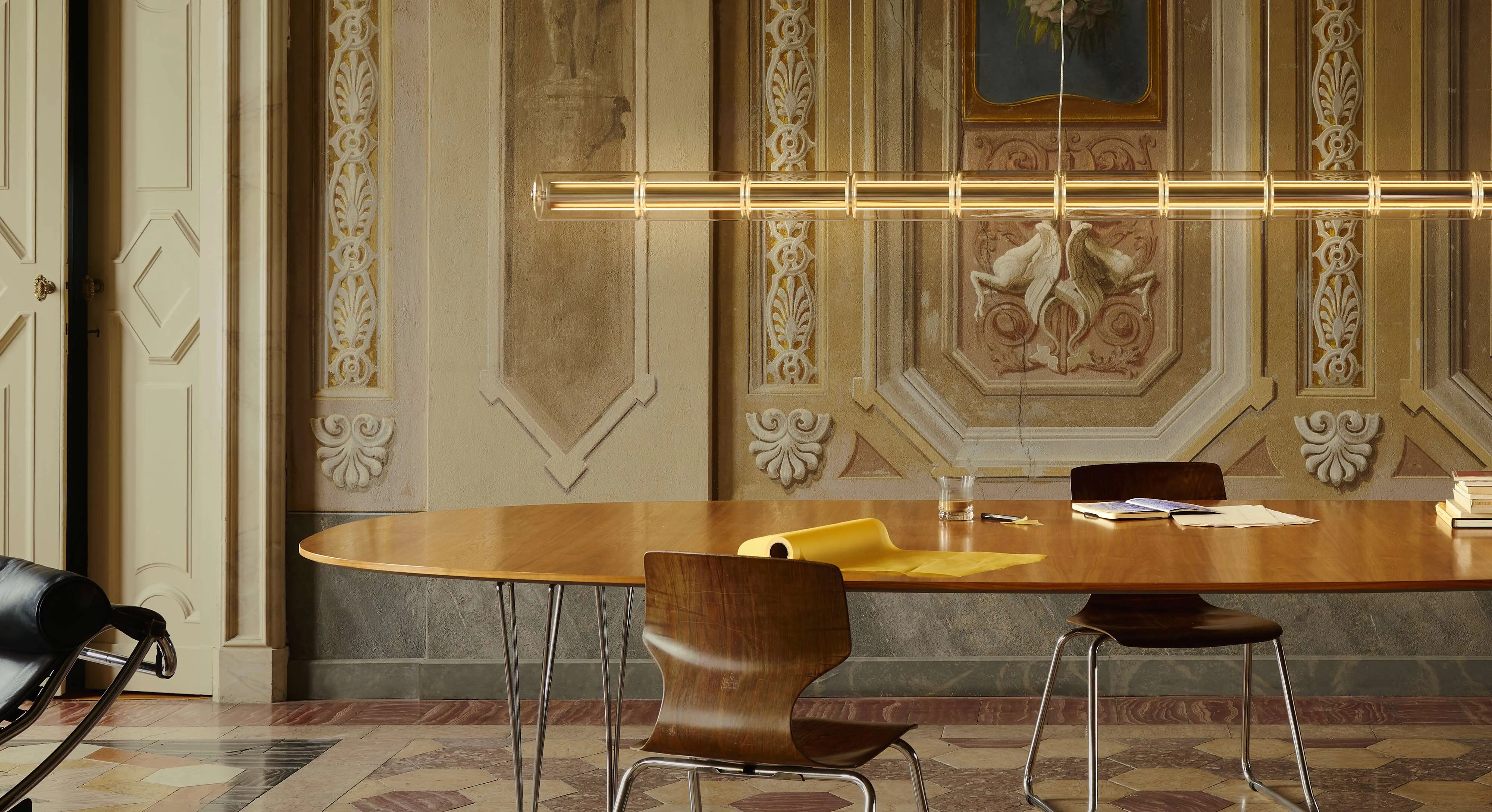
Flos
Founded in 1962, Flos built its reputation on lighting as design object — beginning with Achille and Pier Giacomo Castiglioni (Arco, Taccia) and continuing with designers like Michael Anastassiades, Marcel Wanders and Philippe Starck. The catalog is decorative and sculptural: fittings meant to be seen and remembered, not just to illuminate.
Artemide
Founded in 1960 by Ernesto Gismondi and Sergio Mazza, Artemide pursues “The Human Light” — a human-centered, research-led approach to how light serves people and space. Its icons are as much engineering as design: the Tolomeo, the Tizio, the Eclisse. Multiple Compasso d’Oro awards reflect a function-first identity.
Flos: light as sculpture
Flos designs the moment your eye lands on the fitting. Form, material and presence come first; the glow is the reward. This makes Flos the natural choice for the decorative layer — the pendant over the table, the floor lamp beside the sofa, the piece that gives a room its character.
Artemide: light as function
Artemide designs around the task — reading, working, navigating a space — and around the wellbeing of the people in it. Mechanisms are precise, optics are considered, and the architectural range is built for integration. The result is light you use rather than light you look at.
Flos
Arco
The Castiglioni brothers’ 1962 arching floor lamp with a Carrara marble base — arguably the most recognized design lamp ever made, and still the brand’s signature.
IC Lights
Michael Anastassiades’ 2014 family of balanced spheres on slender stems. Quiet, jewel-like, and one of the defining lighting designs of the last decade.
Taccia
A 1962 Castiglioni table lamp — a glass-and-aluminum bowl that diffuses light upward. Sculptural, warm and unmistakably an object first.
Artemide
Tolomeo
De Lucchi and Fassina’s 1987 spring-balanced task lamp — among the best-selling design lamps in the world, endlessly extended into wall, floor and clamp versions.
Tizio
Richard Sapper’s 1972 counter-balanced desk lamp — a feat of engineering as much as design, and a permanent fixture in the MoMA collection.
Eclisse
Vico Magistretti’s 1967 bedside lamp with a rotating inner shade that “eclipses” the light. A Compasso d’Oro winner and a masterclass in simple mechanism.
Reach for Flos when…
The fitting is part of the design — a decorative pendant, a sculptural floor lamp, a feature that anchors the room. Flos earns its place where the light source is also a focal point.
Reach for Artemide when…
The light has a job to do — task lighting, reading, architectural washes, integrated systems. Artemide is the dependable engine of a scheme, especially across larger or more technical projects.
“We rarely choose one over the other. Artemide does the work; Flos provides the moments. A good scheme needs both.”
Chiara Borgoli, Via della Seta
Frequently asked questions
What is the difference between Flos and Artemide?
Both are landmark Italian lighting houses, but their instincts differ. Flos (founded 1962) treats light as sculpture — emotional, decorative, design-icon led, from the Castiglioni Arco to Anastassiades’ IC Lights. Artemide (founded 1960) follows “The Human Light”: human-centered, technical and research-driven, strongest in task and architectural lighting, from the Tolomeo to the Tizio. Flos is the object on display; Artemide is the light that works.
Which is better for task and architectural lighting?
Artemide. Its DNA is functional, human-centered light — the Tolomeo and Tizio are reference task lamps, and its architectural range is engineered around how people actually use light. Flos has excellent architectural lines too, but its center of gravity is decorative and sculptural.
Which is more expensive, Flos or Artemide?
It depends entirely on the piece, not the brand. Both span accessible icons and premium statement fittings. A Flos table or floor lamp commonly sits in the few-hundred to low-thousands range at trade; Artemide’s Tolomeo is famously attainable for a design classic, while large custom architectural systems from either brand run far higher. We quote per specification.
Can I use both Flos and Artemide in the same project?
Very often the best lighting schemes do. A typical approach uses Artemide for the working layers — task, reading and architectural light — and Flos for the decorative moments that the eye lands on. Coordinating both within a single FF&E specification keeps color temperature, dimming and control consistent across the two.
Building a lighting scheme?
We specify Flos and Artemide together — decorative and functional layers, with consistent color temperature and dimming across both.